In this tab, it is possible to view the peers that have Peer Management enabled in a cluster. These are devices that can be selected to run a Playbook.This page lists the ansible inventories associated with the Nodegrid device. When runnning an ansible-inventory --list command in Ansible, all the inventories are listed on the Inventory tab. For a coordinator, the peers of Cluster are automatically added to the ansible inventory.
Inventory Variable
It is possible to view what variables are in your host inventories.
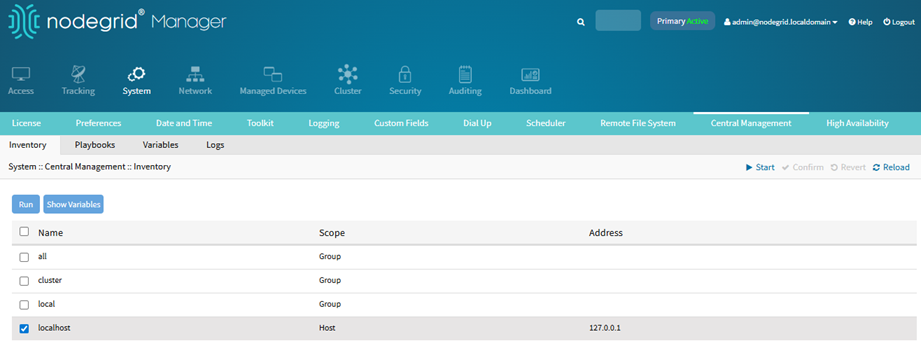
Navigate to SYSTEM::CENTRAL MANAGEMENT::INVENTORY
Current host inventories are displayed
Select the checkbox next to the host inventory
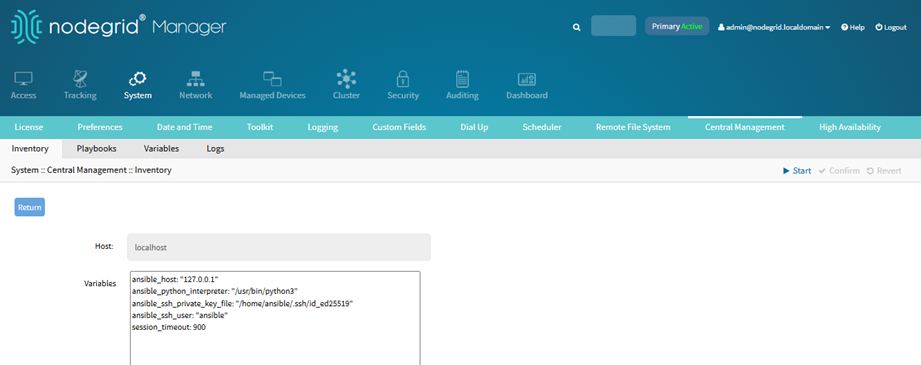
Click on the Show Variables button
The variables for the selected host inventory are displayed
Note
Show Variables button only displays the variables when one host is selected or if the group selected has one host. If it is a group with multiple hosts or if multiple hosts are selected, the button will be grayed out.
Run an Ansible Playbook
Navigate to SYSTEM::CENTRAL MANAGEMENT::INVENTORY
Current host inventories are displayed
Select the checkbox next to the host inventory
Click on the Run button
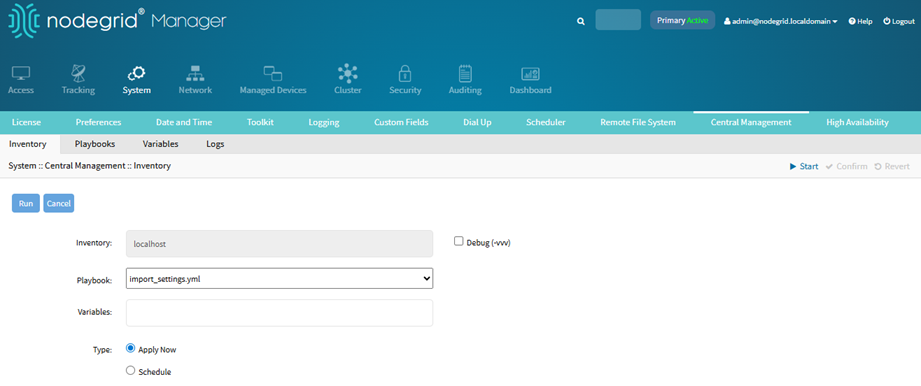
Select the Playbook from the drop-down
Enter Variables. (This is an optional field. Variables entered here have priority over variables created in the Variables tab.)
Examples
Valid input formats:
Filepath: @/etc/ansible/variables/yourfilename.yml
WebUI, CLI and API: Only accepts valid files. File must exist and the ansible user can read.
Json: {"key":"value"} , '{"key":"value"}' , "{"key":"value"}"
yml: key=value ,"key=value key=value" , 'key=value key=value'
Invalid input formats:
Filepath: @/file_not_exist >> Cannot find or access the file.
Filepath: @/root_only_read >> Cannot read file.
Json: '{"name:json_name", "local:json_local"}' >> Invalid JSON format. Extra variable will be ignored according to Ansible’s default behavior, and variable precedence applies.
yml: 'name=value_name local= value_local' >> The extra variable “local” is invalid, so it will be ignored by Ansible, following its default behavior and variable precedence rules.
On Type menu, select one:
Apply Now radio button
Schedule radio button (expands dialog)
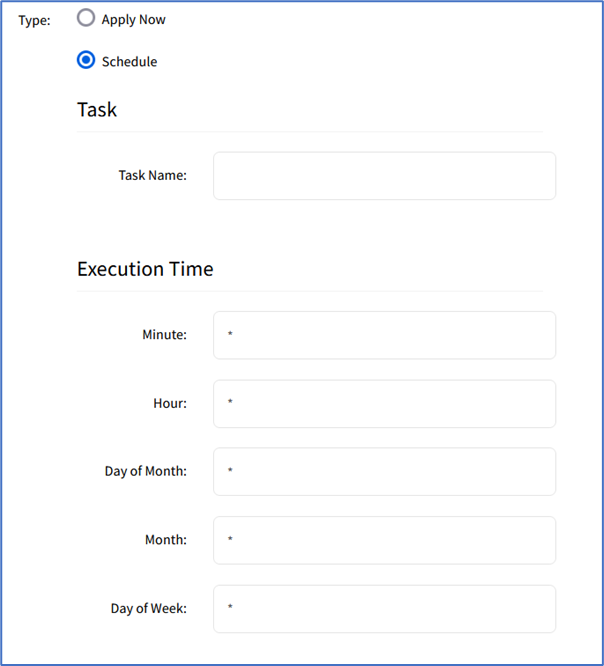
In the Task menu, enter Task Name.
In the Execution Time menu, enter details (see table below).
Click Run.
NOTE
Scheduled tasks can be managed on SYSTEM::SCHEDULER tab.
Execution Time Date/Time examples
Factor | Daily Task: | Every Saturday: | Every Hour |
Minute | 1 | 45 | 0 |
Hour | 0 | 23 | * |
Day of Month | * (every day) | * | * |
Month | * (every month) | * | * |
Day of Week | * (every day of week) | 6 | * |
Debug an Ansible Playbook
When using the -vvv debug option, the log increases the output details like variable values, template rendering, and remote commands that help troubleshoot issues with permissions, connections, or unexpected results.
Navigate to SYSTEM::CENTRAL MANAGEMENT::INVENTORY
Current host inventories are displayed
Select the checkbox next to the host inventory
Click on the Run button
Select a Playbook from the drop-down menu
Select the Debug (-vvv)
Click on the Run button
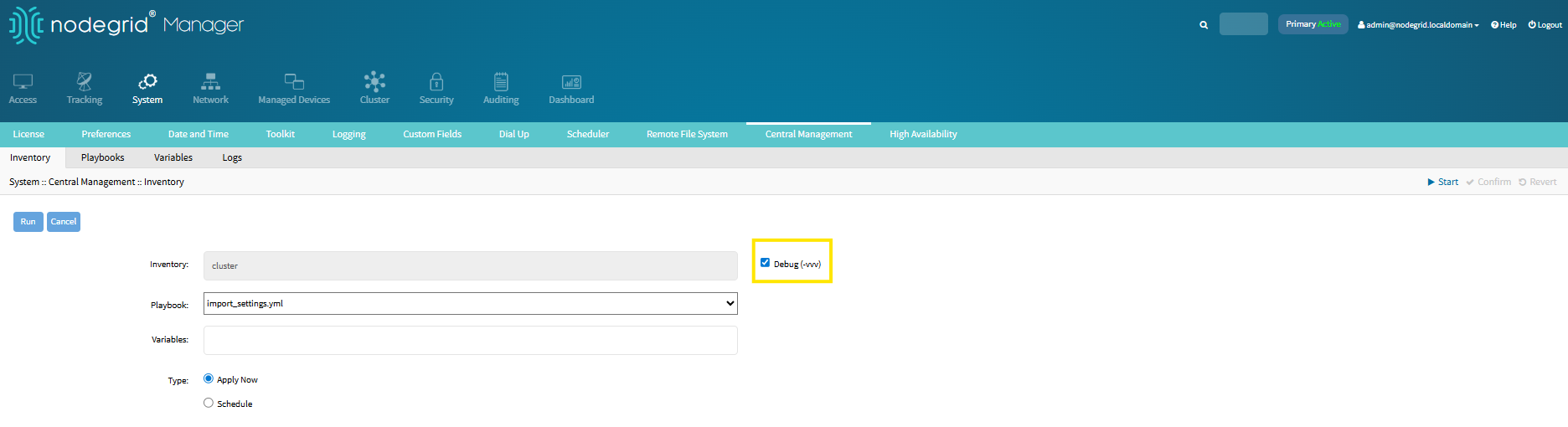
Debug option is selected.
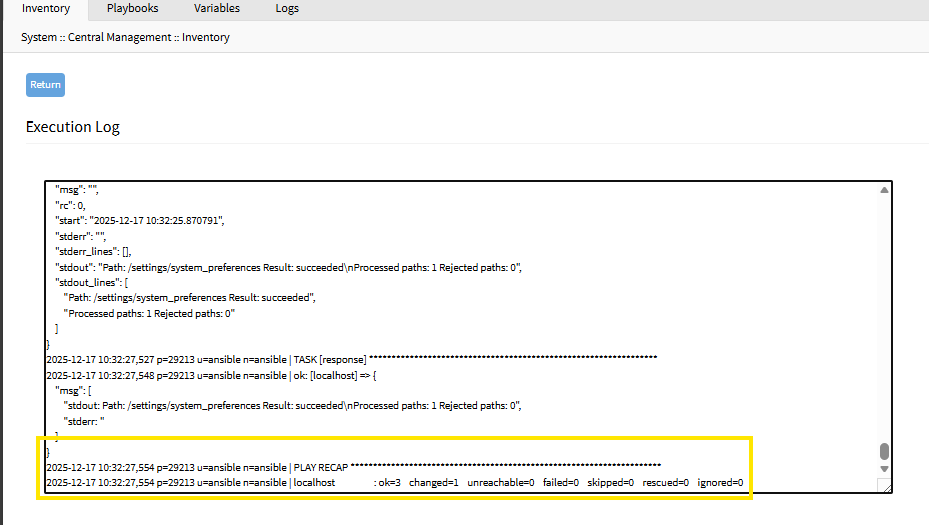
Execution Log displays the PLAY RECAP at the end.