The ZPE Cloud notifications are managed on this page. Users are notified by Email whenever an event occurs, ensuring they stay updated with timely information about relevant actions or changes.
EVENTS
This page configures what events trigger an Email notification.
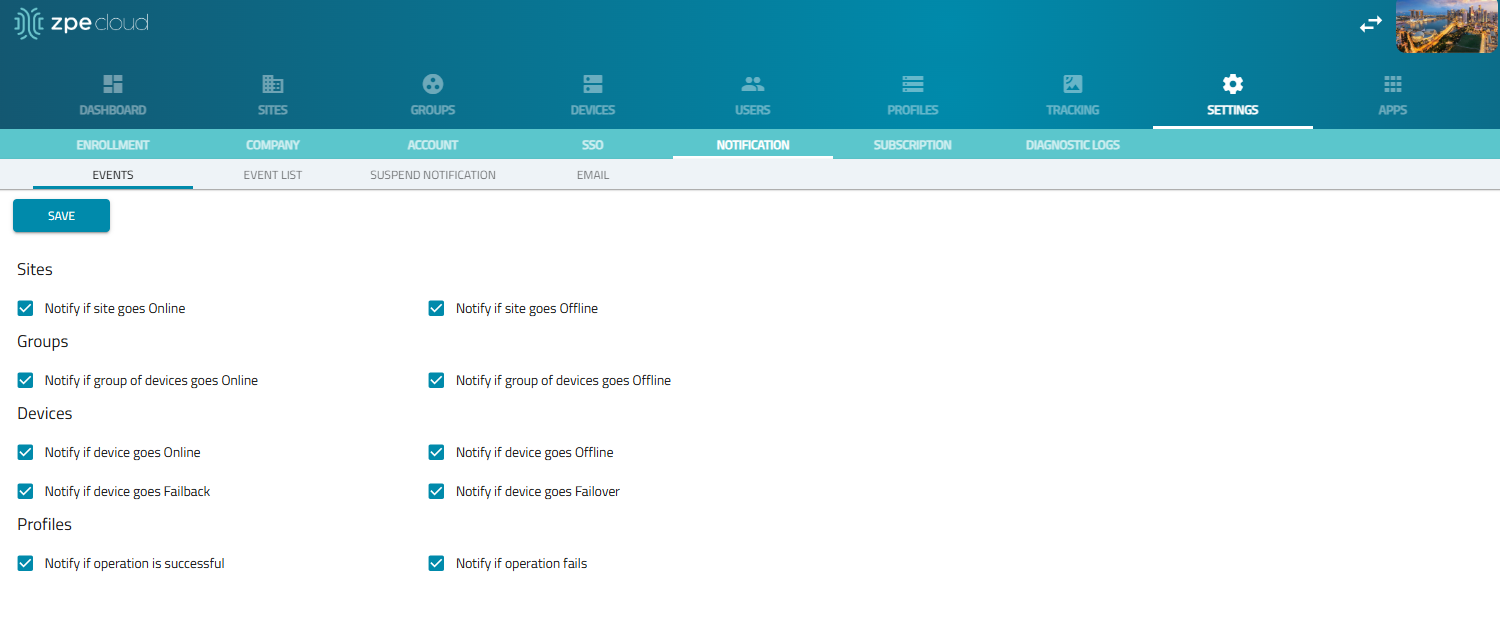
Configure Notification Events
Go to SETTINGS::NOTIFICATION::EVENTS
Select/unselect checkboxes, as neededOn the Sites menu, select Notify if site goes Offline checkbox
This will send notifications when all the devices in a site have disconnected from ZPE Cloud
In the Groups menu:
Select Notify if group of devices goes Online checkbox
This will send a notification after all devices of a group have disconnected, and the first one connects into ZPE Cloud
Select Notify if group of devices goes Offline checkbox
This will send a notification when all the devices in a group have disconnected from ZPE Cloud
In the Devices menu:
Select Notify if device goes Online checkbox
This will send a notification when a device reconnects to ZPE Cloud
Select Notify if device goes Offline checkbox
This will send a notification when a device disconnects to ZPE Cloud
Select Notify if device goes Failover checkbox
This will send a notification when a device stops using the primary interface to connect to ZPE Cloud This is based on the Nodegrid failover configuration
Select Notify if device goes Failback checkbox
This will send a notification when a device returns to the primary interface to connect to ZPE Cloud This is based on Nodegrid failover configuration
In the Profiles menu:
Select Notify if operation is successful checkbox
This will send a notification when a device operation finishes with a successful status
Select Notify if operation fails checkbox
This will send a notification when a device operation finishes with a failure status
Click SAVE to persist the configurations
Configure a Device to Share Events with ZPE Cloud
Nodegrid devices connected to ZPE Cloud do not automatically forward all event categories. Administrator privileges are required to configure it.
Log in to the Nodegrid device
Go to AUDITING::EVENTS::CATEGORIES
In the Events column, click ZPE Cloud (opens dialog)
In the Event Categories menu, select/unselect, as needed.
System Events checkbox
AAA Events checkbox
Device Events checkbox
Logging Events checkbox
ZPE Cloud Events checkbox
Click Save.
EVENTS LIST
The Events List page in ZPE Cloud is located under Settings::Notifications::Event List and provides a comprehensive reference of all the possible system-defined events that may be generated by ZPE Cloud. This page does not display real-time or historical event logs, but instead offers a categorized static reference page of all event types at ZPE Cloud. ZPE Cloud does not provide Events list from Nodegrid, since they differ between Nodegrid OS versions.
The page details the events with the following information:
Code: A unique identifier number code representing this specific type of event. Useful for tracking and filtering logs.
Name: The name of the event.
Priority: Importance level of the event. Classified in: Notification, Warning and Critical.
Category: Events are grouped by category for classification by system area.
Note:
Nodegrid events start at event code 1 to 999. ZPE Cloud events starts at event code number 1000.
Note:
ZPE Cloud aims to simplify the visualization of important events and pre-defines the event priority with the importance level of the events. At some use cases, customers may not give importance to a Critical or Warning priority event, but give importance to a Notification priority event.
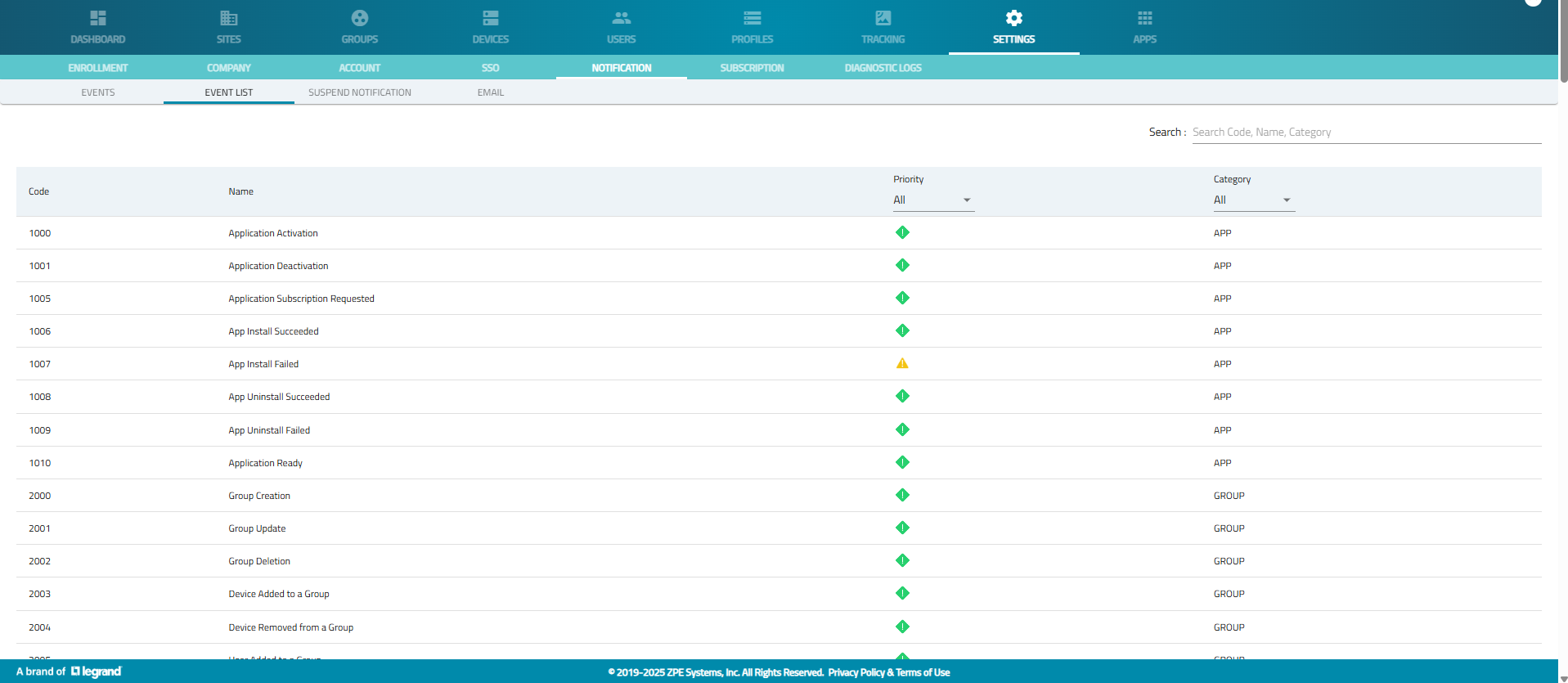
Events list table
This listing shows all the registered events code, name, priority (appliable for Notifications) and associated categories.
Code | Name | Priority | Category |
|---|---|---|---|
1000 | Application Activation |
| APP |
1001 | Application Deactivation |
| APP |
1005 | Application Subscription Requested |
| APP |
1006 | App Install Succeeded |
| APP |
1007 | App Install Failed |
| APP |
1008 | App Uninstall Succeeded |
| APP |
1009 | App Uninstall Failed |
| APP |
1010 | Application Ready |
| APP |
2000 | Group Creation |
| GROUP |
2001 | Group Update |
| GROUP |
2002 | Group Deletion |
| GROUP |
2003 | Device Added to a Group |
| GROUP |
2004 | Device Removed from a Group |
| GROUP |
2005 | User Added to a Group |
| GROUP |
2006 | User Removed from a Group |
| GROUP |
2007 | Group Online |
| GROUP |
2008 | Group Offline |
| GROUP |
3000 | Site Creation |
| SITE |
3001 | Site Update |
| SITE |
3002 | Site Deletion |
| SITE |
3003 | Device Added to a Site |
| SITE |
3004 | Device Removed from a Site |
| SITE |
3005 | Site Online |
| SITE |
3006 | Site Offline |
| SITE |
4000 | Device Connection Success |
| DEVICE |
4001 | Device Connection Failed |
| DEVICE |
4002 | Device On-Premise Received |
| DEVICE |
4003 | Device Removed |
| DEVICE |
4004 | Device Added by Key |
| DEVICE |
4005 | Device Added by Claim ID |
| DEVICE |
4006 | Device Purged |
| DEVICE |
4007 | Cellular Upgrade Requested |
| DEVICE |
4008 | Device Reaching Data Consumption |
| DEVICE |
4009 | Device Reached Data Consumption |
| DEVICE |
4010 | Device Available |
| DEVICE |
4011 | Device Enrolled |
| DEVICE |
4012 | Device Unrolled |
| DEVICE |
4013 | Device Transfer Pending Request |
| DEVICE |
4014 | Device Failover |
| DEVICE |
4015 | Device Failback |
| DEVICE |
4016 | Device Online |
| DEVICE |
4017 | Device Offline |
| DEVICE |
5000 | User Unlock Success |
| USER |
5001 | User Lock Success |
| USER |
5002 | User Creation |
| USER |
5003 | User Update |
| USER |
5004 | User Deletion |
| USER |
5005 | User Authentication Success |
| USER |
5006 | User Authentication Failed |
| USER |
5007 | User SSO Authentication Success |
| USER |
5008 | User Logged Out |
| USER |
5009 | User Device Access |
| USER |
5010 | User Recovery Key Creation |
| USER |
5011 | SSO User Converted to Local User |
| USER |
5012 | User Downloaded Cloud Logs |
| USER |
5013 | User Downloaded Device Logs |
| USER |
5014 | Configuration Changed |
| USER |
5015 | Multi-Factor Authentication Configured |
| USER |
5016 | Multi-Factor Authentication Reset |
| USER |
5017 | User Recovery Key Authentication Success |
| USER |
5018 | User Changed Authentication Methods |
| USER |
5019 | User Invited |
| USER |
5020 | User Joined |
| USER |
5021 | User Rejected |
| USER |
5022 | Switch Organization Success |
| USER |
5023 | Organization Approved |
| USER |
5024 | Organization Rejected |
| USER |
5025 | Log Mask Operation Successful |
| USER |
5026 | Log Mask Operation Failed |
| USER |
5027 | User OIDC Authentication Success |
| USER |
5028 | User Session Terminated |
| USER |
6000 | Script Creation |
| PROFILE |
6001 | Script Update |
| PROFILE |
6002 | Script Deletion |
| PROFILE |
6003 | Configuration Creation |
| PROFILE |
6004 | Configuration Update |
| PROFILE |
6005 | Configuration Deletion |
| PROFILE |
6006 | Template Creation |
| PROFILE |
6007 | Template Update |
| PROFILE |
6008 | Template Deletion |
| PROFILE |
6009 | Backup failed |
| PROFILE |
6010 | Scheduled Backup failed |
| PROFILE |
7000 | SSO Creation |
| SSO |
7001 | SSO Deletion |
| SSO |
7002 | OIDC Created |
| SSO |
7003 | OIDC Deleted |
| SSO |
7004 | OIDC Updated |
| SSO |
8000 | Company Details Update |
| COMPANY |
8001 | On-Premise Configured |
| COMPANY |
8002 | On-Premise Disabled |
| COMPANY |
8003 | IP Whitelist Configuration |
| COMPANY |
8004 | Enrollment Enabled |
| COMPANY |
8005 | Enrollment Disabled |
| COMPANY |
8006 | Company Registration Request |
| COMPANY |
9000 | Operation Finished |
| OPERATION |
9001 | Operation Created |
| OPERATION |
9002 | Scheduled Operation Created |
| OPERATION |
9003 | Operation Failed |
| OPERATION |
9004 | Recurrent Operation Created |
| OPERATION |
9005 | Recurrent Operation Updated |
| OPERATION |
9006 | Recurrent Operation Deleted |
| OPERATION |
9007 | Recurrent Operation Expired |
| OPERATION |
10000 | License Created |
| LICENSE |
10001 | License Deleted |
| LICENSE |
10002 | License Expiry |
| LICENSE |
10003 | Grace Period Expiry |
| LICENSE |
10004 | Trial Expiry |
| LICENSE |
10005 | App License Expiry |
| LICENSE |
10006 | App Grace Period Expiry |
| LICENSE |
10007 | App Trial Expiry |
| LICENSE |
11000 | Extended Storage Limit Reached |
| EXTENDED STORAGE |
11001 | Extended Storage Reached Eighty Percent Limit |
| EXTENDED STORAGE |
12000 | SD-WAN Topology Created |
| SD-WAN |
12001 | SD-WAN Topology Updated |
| SD-WAN |
12002 | SD-WAN Topology Deleted |
| SD-WAN |
12003 | SD-WAN Added Device to Topology |
| SD-WAN |
12004 | SD-WAN Remove Device from Topology |
| SD-WAN |



SUSPEND NOTIFICATION
Configure a Notification Delay
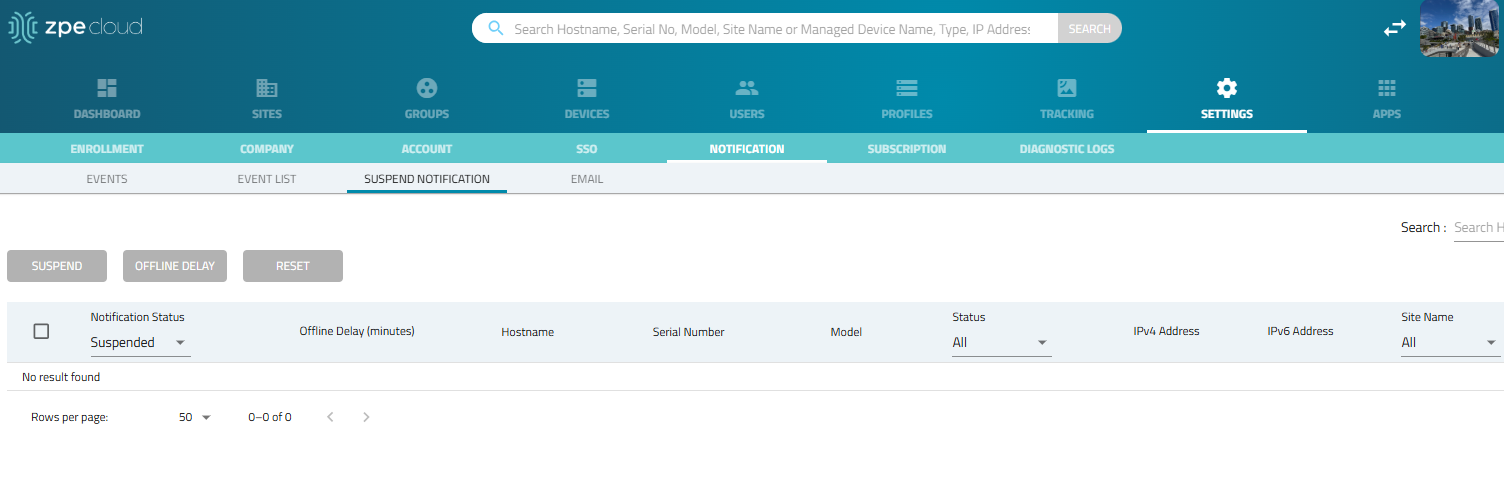
Go to SETTINGS::NOTIFICATION::SUSPEND NOTIFICATION
A list of all the devices with suspended notifications are displayed by default
Click to filter the Notification Status drop-down by All
The list of all enrolled devices in the ZPE Cloud company account are displayed
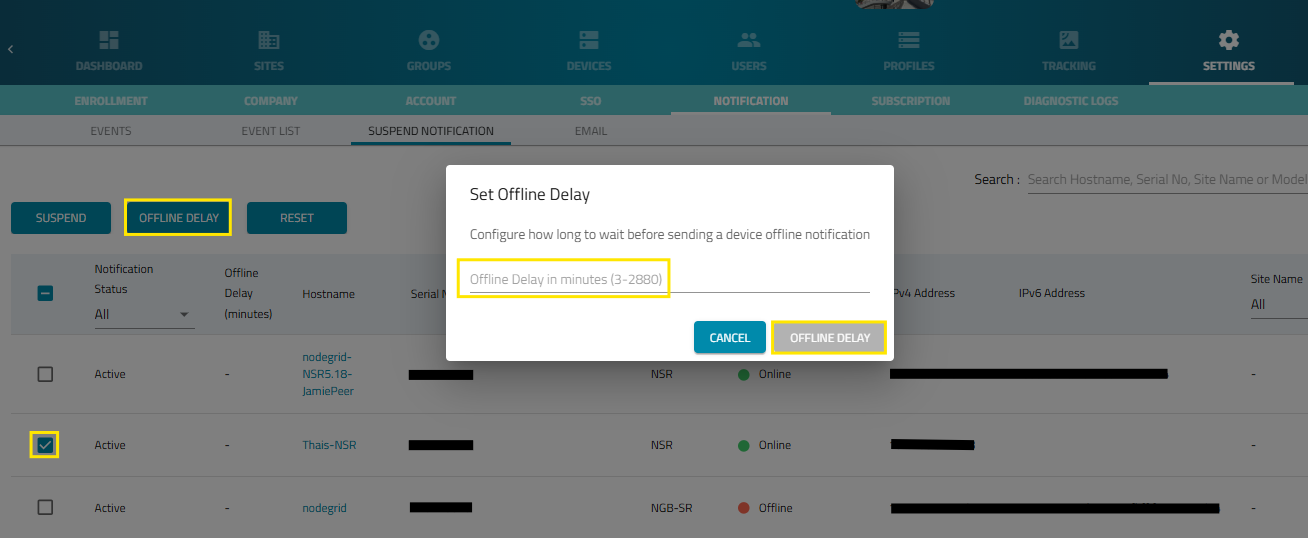
Select the checkbox of a device to configure the notification offline delay
Click the OFFLINE DELAY button
Offline Delay confirmation box is displayed
Enter the delay of how long a device disconnection should be to generate an Offline notification
This can be between 3-2880 minutes (48h)
Click on the OFFLINE DELAY button to save
Note
The default Offline delay value is 15 minutes when Suspend or Offline Delay are not configured by the User.
Suspend a Notification Delay
Go to SETTINGS::NOTIFICATION::SUSPEND NOTIFICATION
A list of all the devices with suspended notifications are displayed by default
Click to filter the Notification Status drop-down by All
The list of all enrolled devices in the ZPE Cloud company account are displayed
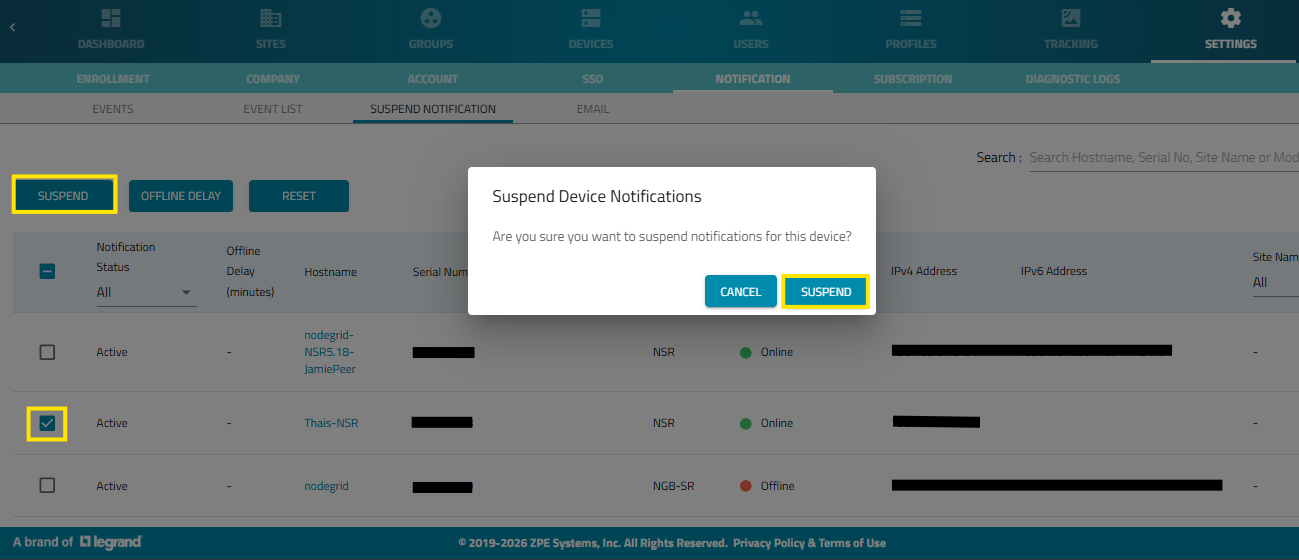
Select the checkbox of a device to configure the notification suspension
Click the SUSPEND button
A confirmation box is displayedClick on the SUSPEND confirmation button to save
Now any new notification related to the device will not be generated
Reset a Notification Delay
Go to SETTINGS::NOTIFICATION::SUSPEND NOTIFICATION
A list of all the devices with suspended notifications are displayed by default
Click to filter the Notification Status drop-down by All
The list of all enrolled devices in the ZPE Cloud company account are displayed
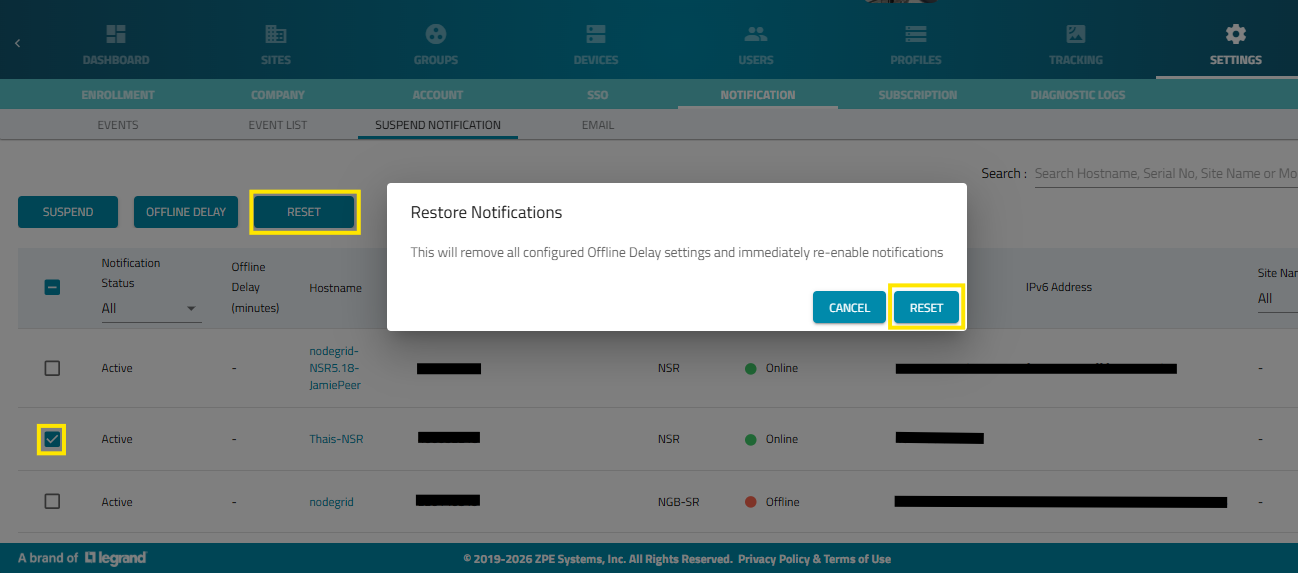
Select the checkbox of a device to reset the configuration of notification suspension and offline delay
Click the RESET button
A confirmation box is displayedClick on the RESET confirmation button to save
Now any new notification related to the device will be generated on the default system behavior (3min of notification delay set by default)
If users wish to receive emails about the ZPE Cloud notifications, you can configure their emails on this page. To do this, follow the steps mentioned in the procedure Configure Email Notifications for User.
ZPE Cloud mainly supports two types of notifications:
Alert Notifications: ZPE Cloud provides notifications of the events on enrolled devices. The emails are triggered when a device takes a specific action. For more information on alert notifications, see the Notifications section.
System Notifications: These include general announcements or interactions from the Operations team, such as system maintenance updates or customer support interactions.
NOTE
System notifications may also be sent within ZPE for certain internal actions, such as when a customer requests a new account creation. However, the information on these notifications are beyond the scope of this document. For more information, contact ZPE support.
Email Subject Line - ZPE Notifications
When sending email notifications via ZPE Cloud, the subject line plays a key role in giving recipients a clear and concise preview of the message content. The following tables outline the subject lines used for each type of ZPE Cloud notification, along with a brief description of their purpose.
Alert Notifications
Email Subject Line | Description |
|---|---|
Devices enrolled | Sent when devices are successfully enrolled in the ZPE Cloud. |
ZPE Cloud - <notification> | Sent to users when devices and apps have taken an action depending upon the preferences set on the Events page. |
Failed to send device to On-Premise Instance | Sent when moving a device from ZPE Cloud to On-Premise instance has failed. |
System Notifications
Email Subject Line | Description |
|---|---|
ZPE Cloud Trial Invitation | Administrators invite users to the ZPE Cloud. |
Create your password | Sent to users when they are invited to set up a local account. |
Invitation | Sent when a Customer Administrator invitation is required in a company. |
Registration | Sent when users want to create an account for their organization. This is applicable to the already registered, newly registered, and unregistered users. |
Account Created | Sent after an administrator approves a user for account creation. |
Forgot Password | Sent to reset a password. |
ZPE Cloud - Subscription Report | Sent when ZPE Cloud metrics are shared with all ZPE Cloud users. |
New Release Notification | Sent when there is a ZPE Cloud software update. |
App name app trial expiration App name app subscription expiration | Sent to indicate license expiry alert. |
Configure Email Notification for User
Make checkbox selections, as needed.
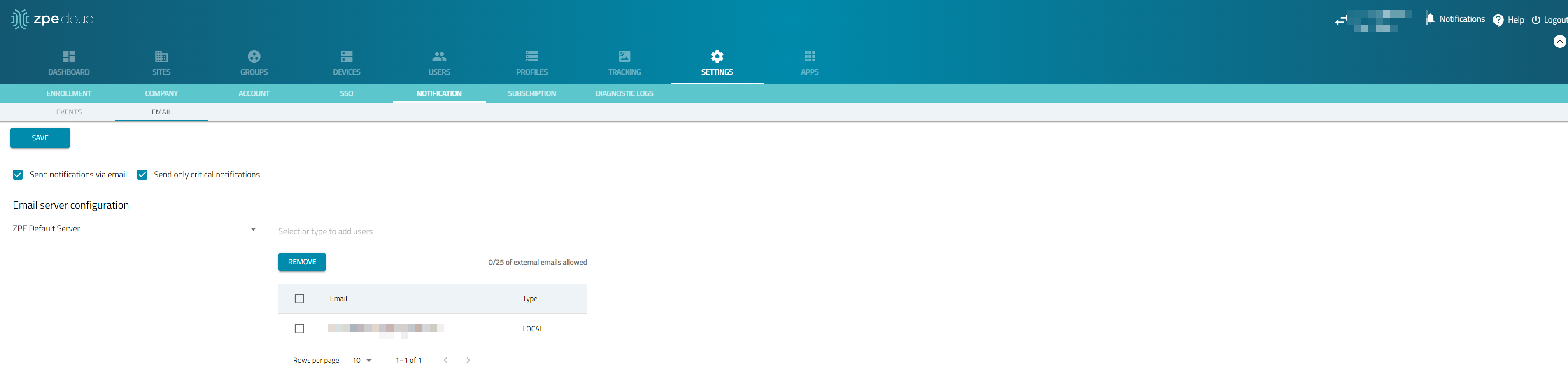
Go to SETTINGS::NOTIFICATIONS::EMAIL
Select the Send notifications via email checkbox
Select the Send only critical notifications checkbox
NOTE:
Enabling this option does not send all notifications to users. Notifications will be received for offline devices, groups, and sites, as well as when a device fails (to assist users with troubleshooting). If you would want to receive all notifications, you must uncheck this option.
On the Email server configuration drop-down, select one:
If ZPE Default server, select or type the email address to which notifications should be sent. This can be the email of a user registered with ZPE Cloud or an external email address.
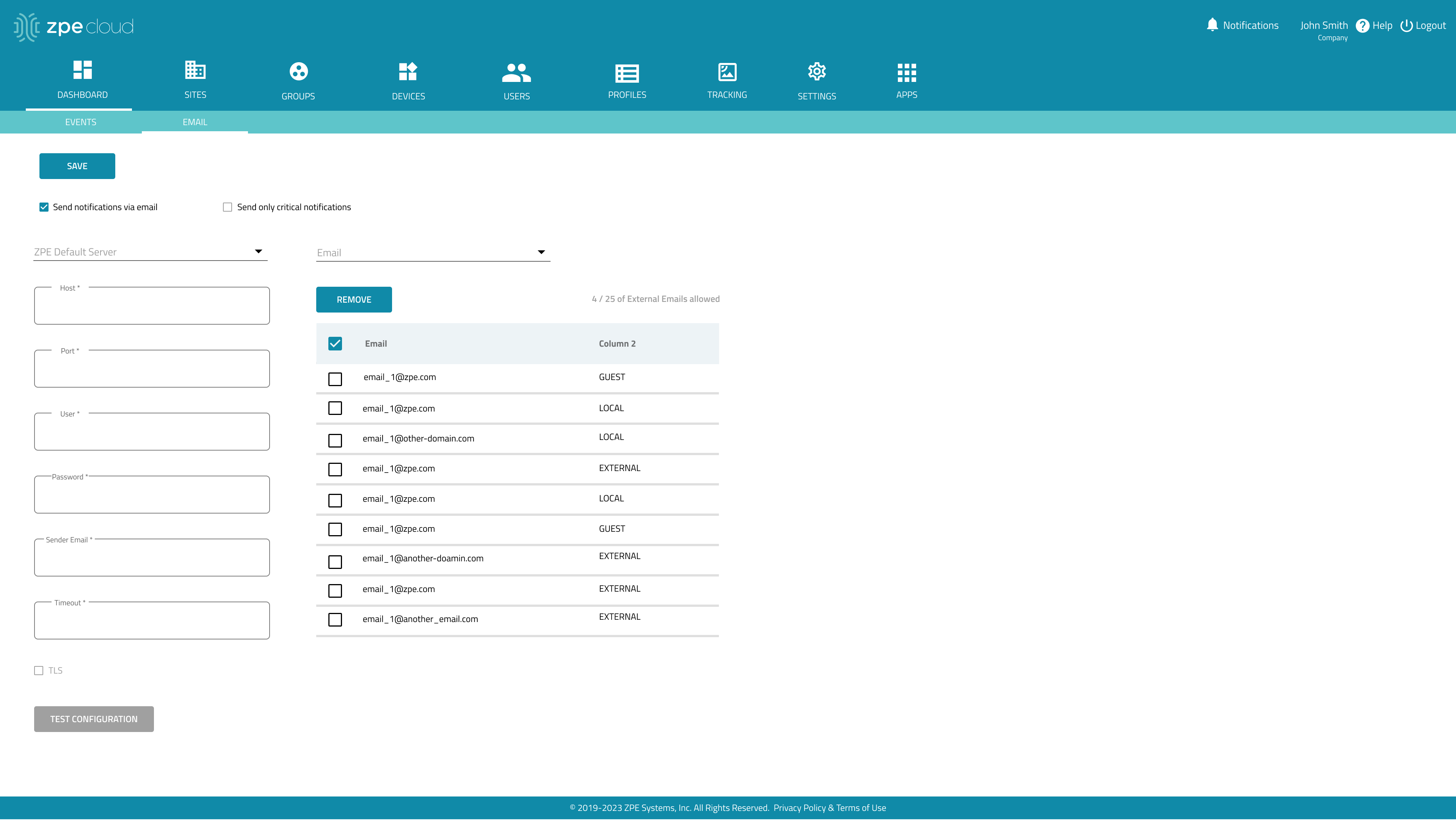
If SMTP(expands dialog):
Enter Host, Port, User, Password, Sender Email, Timeout. Optionally, select the TLS checkbox
.png)
Select or type the email address to which notifications should be sent. This can be the email of a user registered with ZPE Cloud or an external email address
To validate, click TEST CONFIGURATION. If an email is received, the settings are correct
Click SAVE.